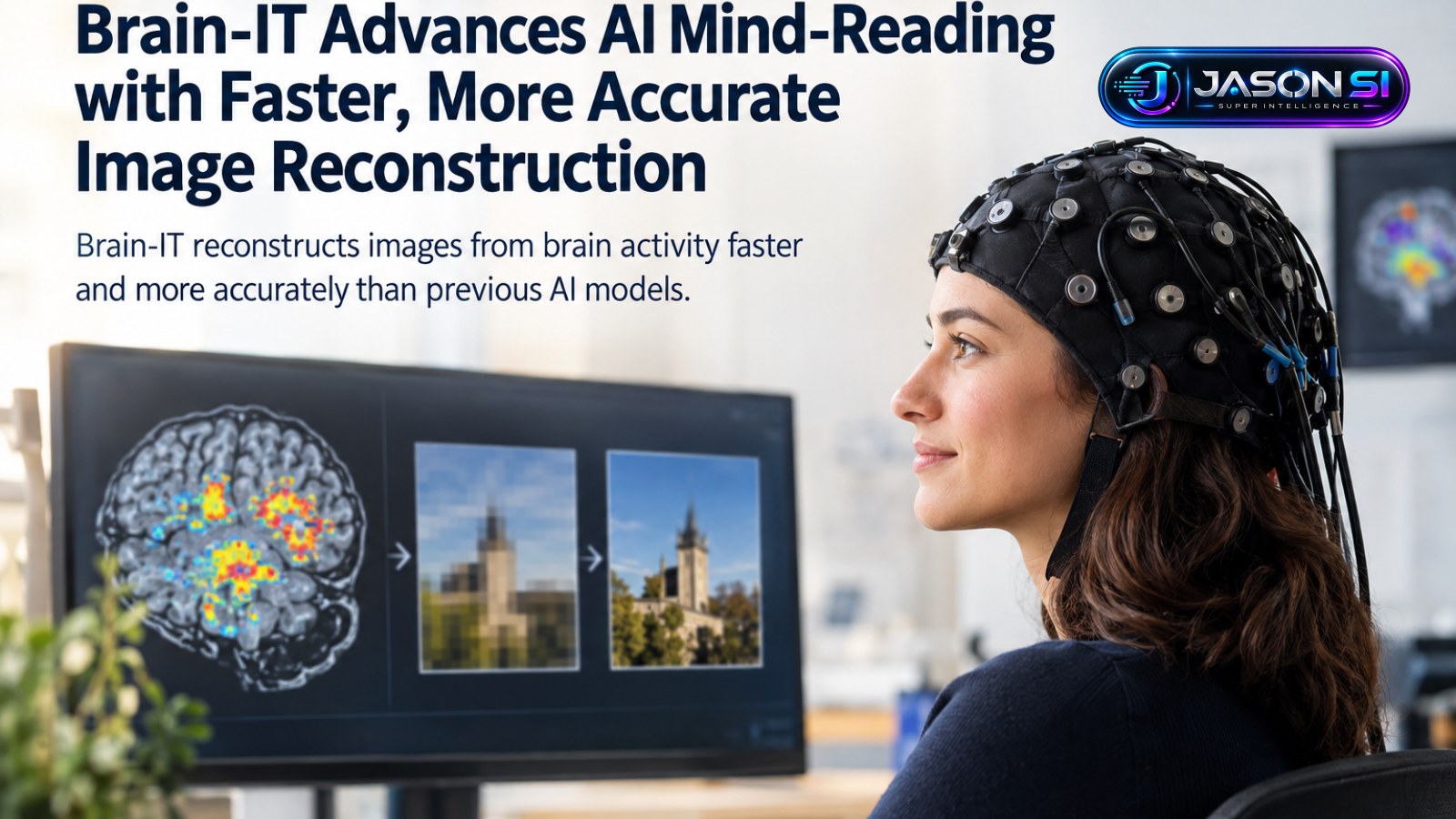
Recent developments in artificial intelligence have brought us closer to decoding human brain activity in ways that could transform how we understand perception. The Brain-IT model, developed by Prof. Michal Irani’s team at the Weizmann Institute of Science, demonstrates a significant leap in reconstructing images seen by individuals based solely on their brain scans.
How Brain-IT Works and Its Innovations
Brain-IT employs a dual-model approach combining an encoder and a decoder. The encoder predicts brain activity patterns from images, while the decoder reconstructs images from brain scans. This bidirectional training overcomes the challenge of limited brain scan data, effectively generating a large dataset by simulating brain activity for images not actually viewed during MRI scanning.
By breaking down brain scans into approximately 40,000 tiny units called voxels, the model identifies shared functional regions across different individuals’ brains. This allows Brain-IT to generalise its decoding capability rapidly, requiring only about one hour of brain scan data from a new person—far less than previous models that needed dozens of hours.
Interestingly, the encoder itself has revealed 128 functional brain regions involved in image processing, some previously unknown to neuroscience. This insight could further aid understanding of how the brain processes visual information.
Implications for AI, Business, and Practical Adoption
- Speed and Efficiency: Brain-IT’s rapid adaptation to new individuals reduces the time and cost associated with personalised AI models in brain decoding.
- Cross-User Generalisation: By recognising universal brain activity patterns, the model can serve broader applications without extensive individual training.
- Potential Applications: While practical consumer or business uses remain exploratory, such technology could eventually enhance brain-computer interfaces, user experience research, and assistive technologies.
- Data Challenges: The scarcity of large-scale brain scan datasets remains a bottleneck, though Brain-IT’s approach mitigates this issue.
It is important to note that the current capabilities do not equate to literal mind-reading or direct access to thoughts, but rather image reconstruction from neural activity patterns under controlled conditions.
For businesses exploring AI-driven innovation in workflow automation, user engagement, or cognitive research, understanding models like Brain-IT highlights the evolving landscape of AI’s intersection with human cognition. JASON SI provides insights and tools to help organisations navigate such emerging technologies responsibly and effectively. Learn more at https://jason-si.com.
Scope and Disclaimer: This article discusses AI research on brain image reconstruction based on functional MRI data. It does not imply any medical, therapeutic, or diagnostic use. Practical applications remain in early stages and require further validation.